Yesterday I released a new Youtube Video with the same title.
Go check it out!
There are a few other key factors to interpretive hand stitching, improvisational hand stitching, expressionist hand stitching or whatever else you might want to call it. I think all of these are good descriptors of my process when taking a piece of linen and starting to stitch on it.
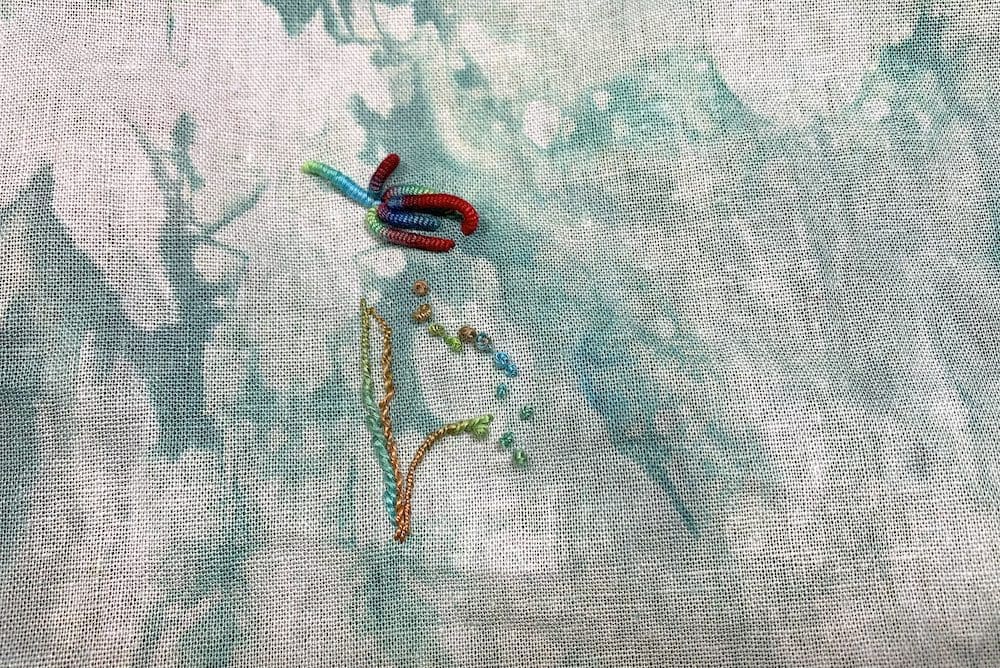
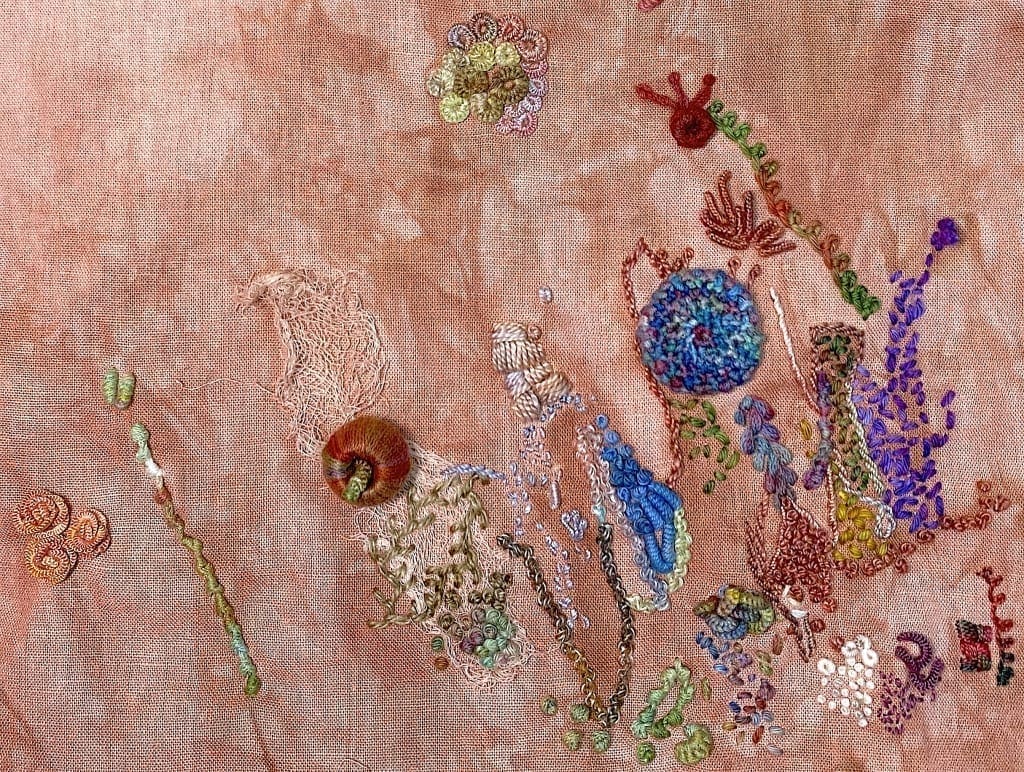
The first few stitches
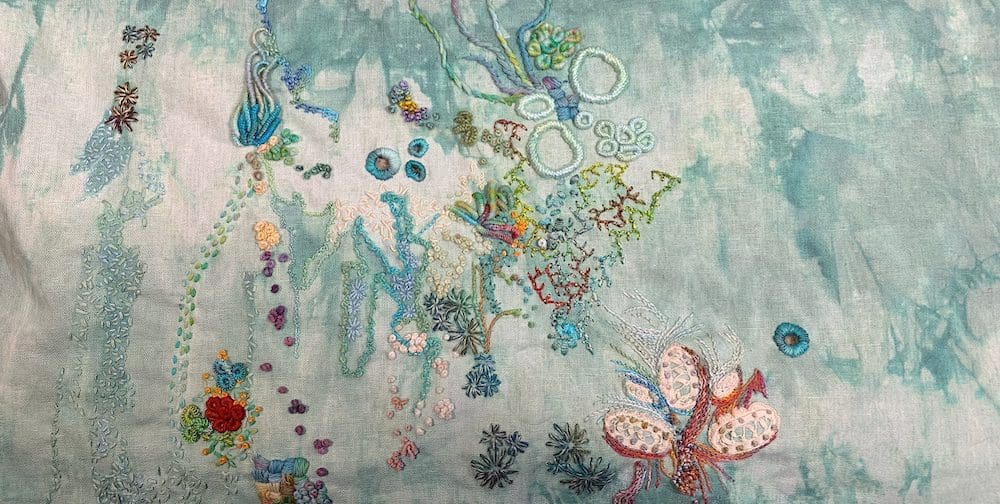
However at a certain point, composition plays a key role in how the piece evolves. It’s not enough to just stitch and hope for the best. Without a good composition it can look like a bunch of disparate parts, each might be lovely taken on their own, but they aren’t necessarily interacting well with one another.
More stitching added…
Another common issue is that one part can take over, drowning out everything else; this brings its own set of challenges. Or perhaps the whole thing is stagnant. There’s not a great deal of movement, so it’s important to know when these things are happening and why. Without knowing why, it is nearly impossible to remedy.
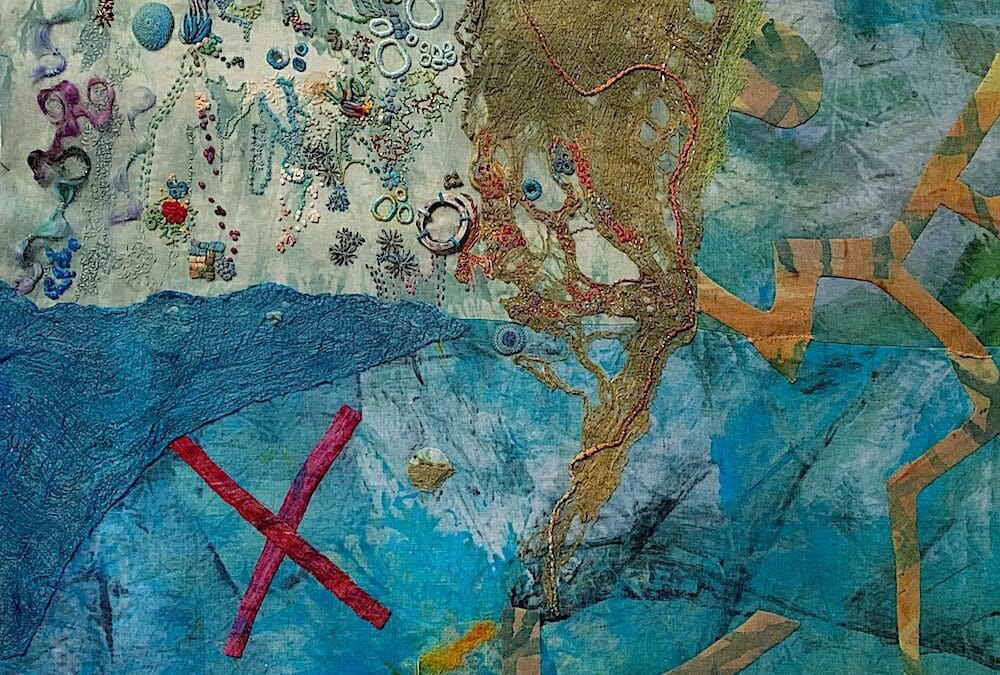
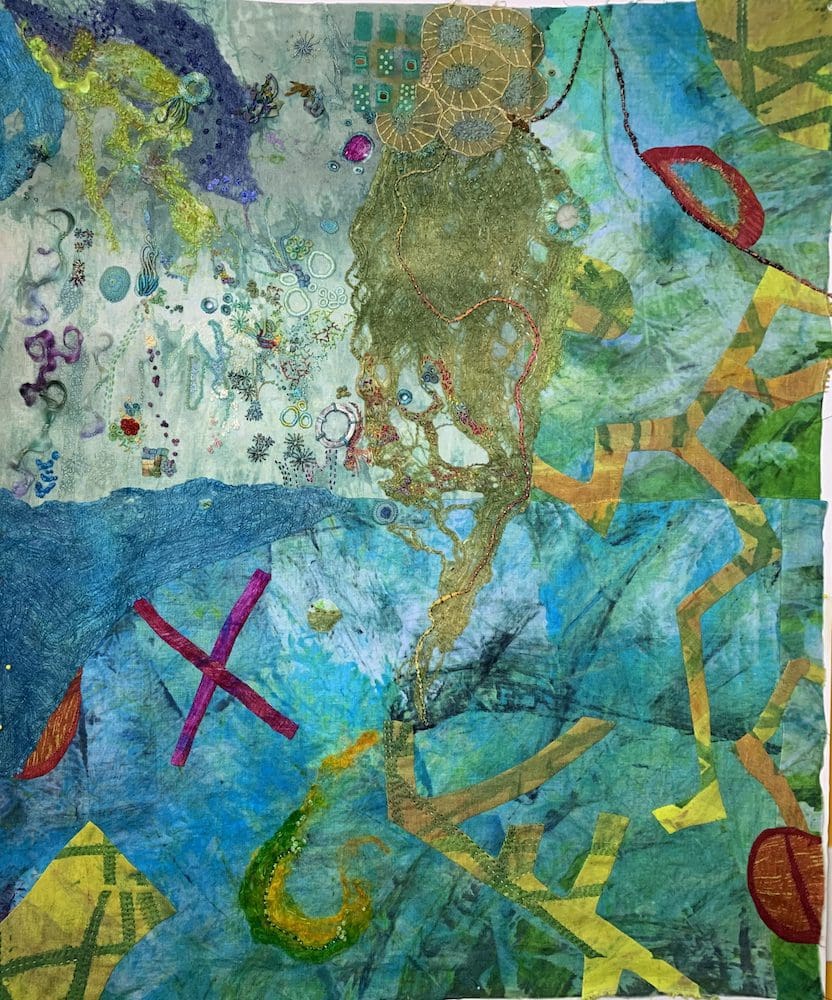
Once the large X was removed the two half moons in the upper right and again in the lower left began to dominate
The trick then is to resolve the “divas” and figure out how to turn the volume down or remove them. In this case, I had to remove it. Between the shape and color it was too much. Except that when it was removed, I was faced with a new challenge.
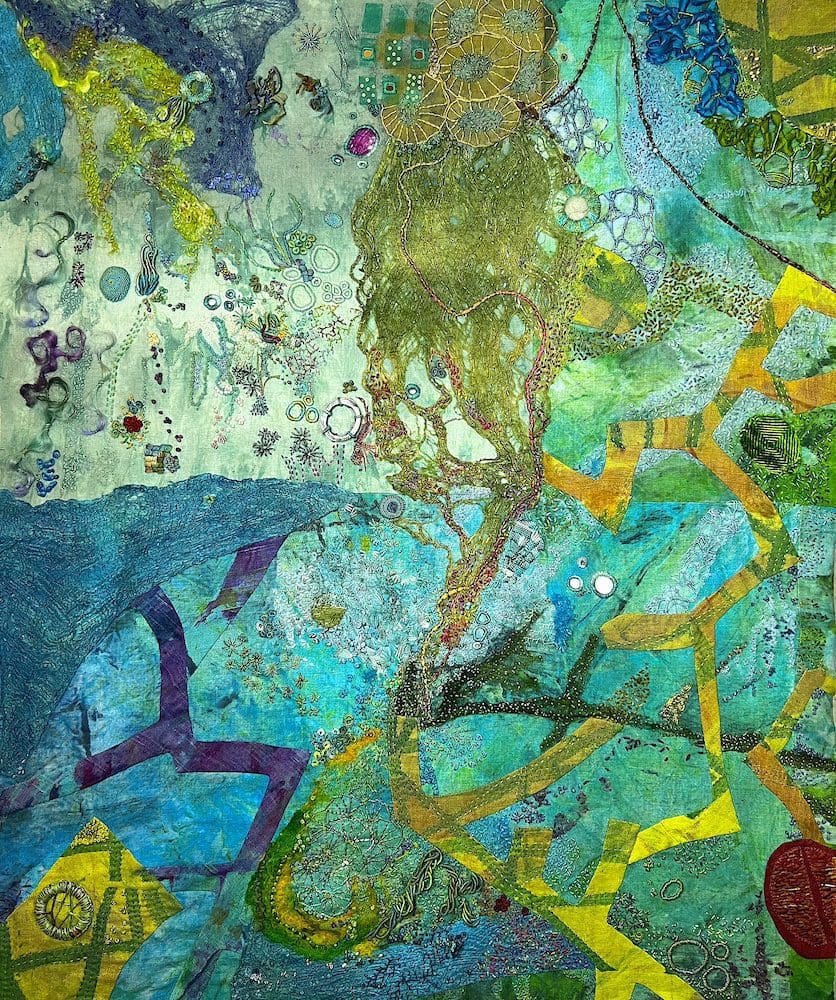
Piece without the darker shapes
So that’s where I am right now. I’m sitting with the challenge of having removed three domineering shapes. Taken on their own, they were fine, but when seen as a whole they were dominating. Except now the piece isn’t grounded. It’s lost some of its vigor. Partly that’s due to the removal of the color, which lended a great deal to the overall piece. So now I have to figure out how to pull it together, give it some excitement. And this is how it goes. There’s a kind of ebb and flow that inevitably happens when working on a piece like this. Take away some aspect and suddenly there’s a new set of challenges.
The key is to not give in to discouragement. To keep going no matter what. To keep trying new things. Thinking out of the box, pushing the boundaries of what I know how to do, trying something I’ve not tried before, test out other colors or reintroduce a color I’ve removed and see how that shifts the conversation.
This is the process that is interpretive hand stitching. Where one idea leads to another and another and another and on it goes.
In 2015 or was it 2016(?) things were in flux. I was re-evaluating what I was doing, where I was headed, what I wanted… There were a number of things going on that led to this, but it was one of those moments that didn’t seem particularly extraordinary or even interesting, but in hindsight I see that it was a pivotal moment. A moment when I re-found hand stitching.
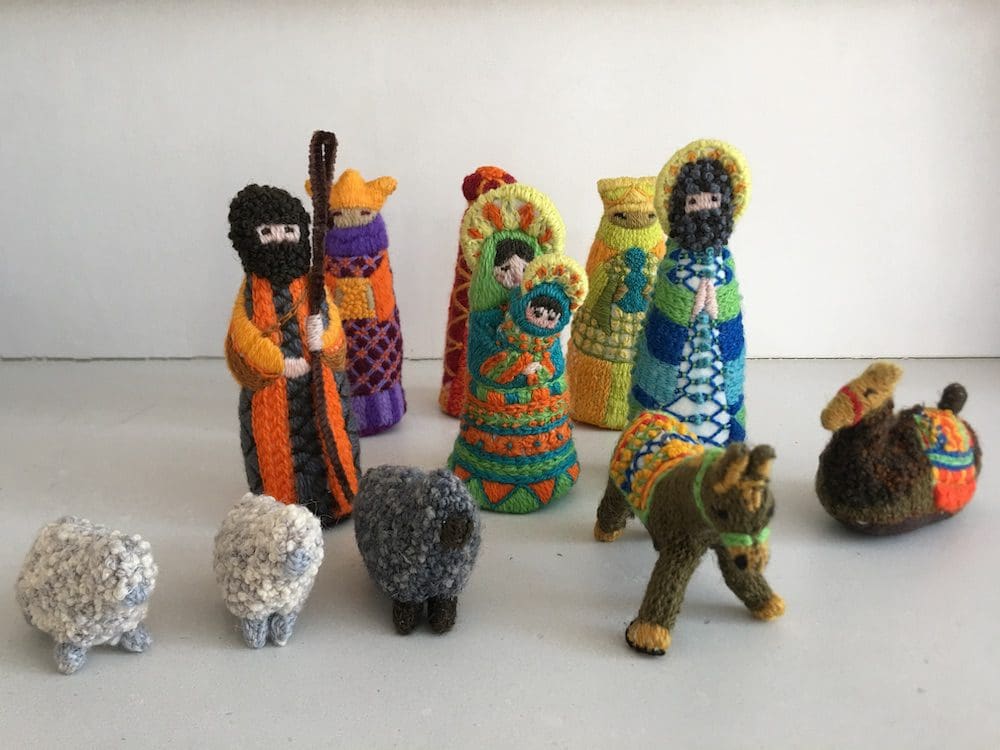
My mother taught me to embroider with crewel and a hoop at an early age. This is the Christmas creche we made together. It was while making one of those sheep that I came to truly appreciate the diversity and beauty of the simple French Knot done hundreds of times.
Christmas Creche embroidered with my mother
Since then I have gone down many paths, but the hand stitching path is perhaps the most surprising, to me. While at Parsons School of Design I would do anything I could to avoid hand stitching. And then I discovered draping and for a time it was my new love. Draping is a whole art in and of itself. Cutting fabric on the bias and then draping it onto a form and manipulating it so the fabric falls in specific ways was something I loved, but it was also time consuming and I was young and impatient and so my love for draping was set aside.
Funnily enough when I moved to Los Angeles straight out of high school and before I went to Parsons my first job was in a tailor’s shop in Beverly Hills. My favorite thing to do was to sit in the back room with the master tailor, an Armenian man who tried to teach me the fine art of tailoring. Hand stitching hemlines and buttonholes was something I never quite mastered during my time there, but I loved it never-the-less.
Hand stitching can be slow and arduous and very, very time consuming, and it can also be meditative, serene, calming and restorative, depending on one’s perspective. These days I find hand stitching to be all of the latter and none of the former.
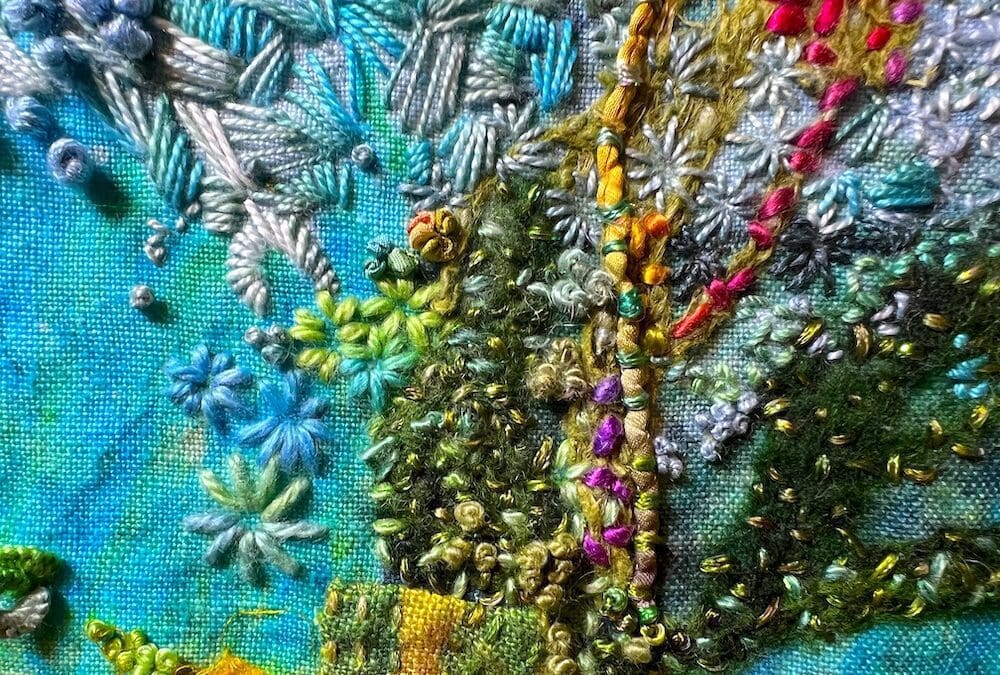
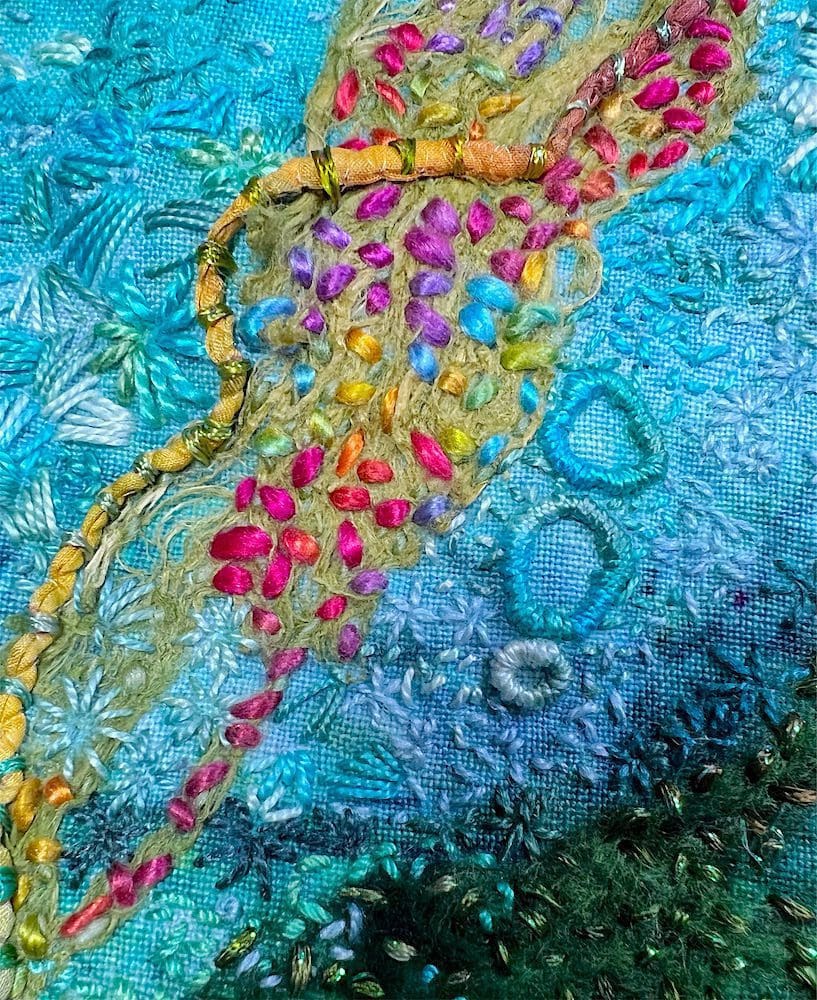
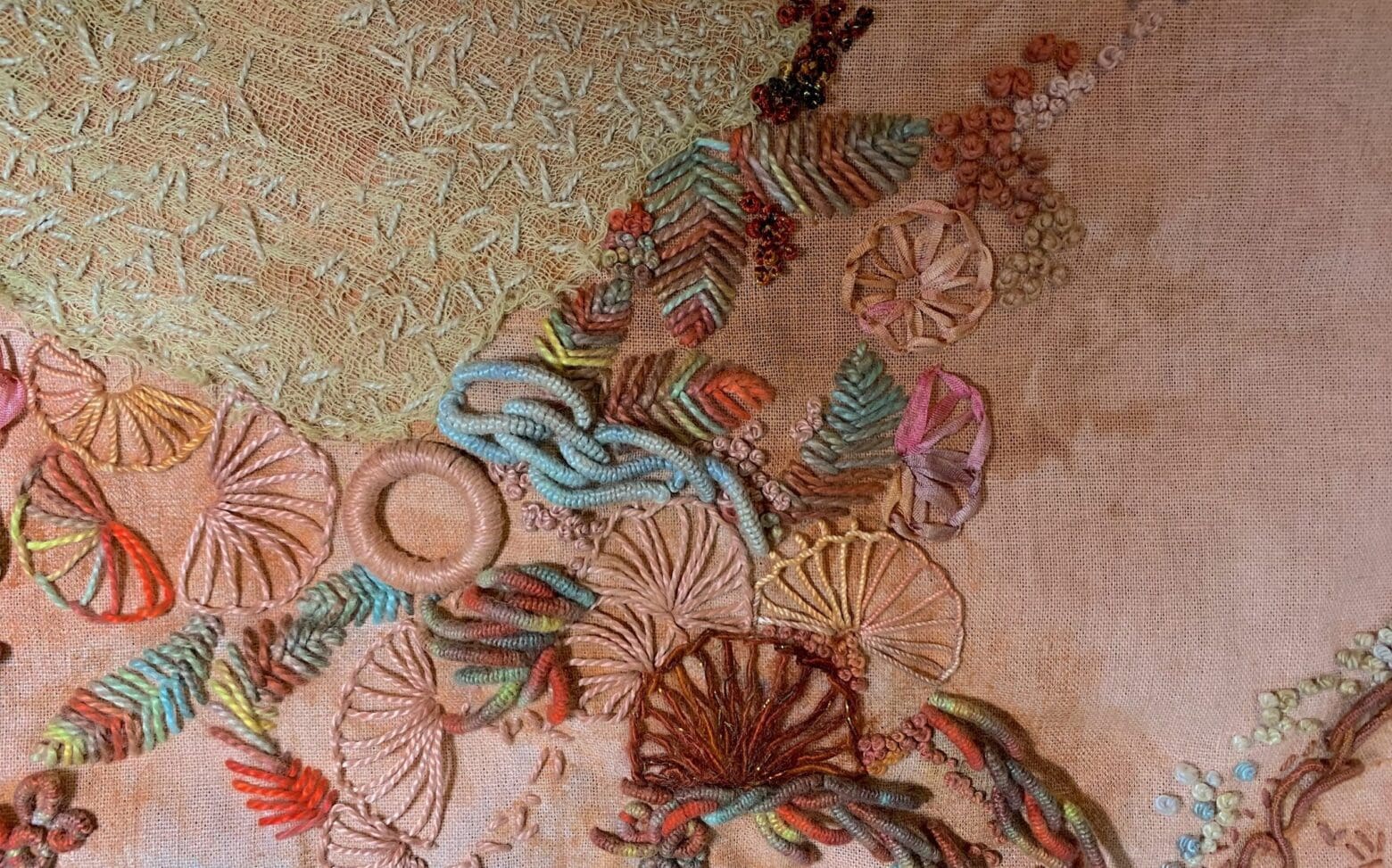
A detail of my most recent work hand stitching on Pat Pauly hand dyed linen using Stef Francis threads, Painter’s Threads, House Of Embroidery Threads, Mulberry Bark from Stef Francis, Sari Cording from Stef Francis and wool roving.
When I began hand stitching again I followed other people’s patterns and instructions and while that was interesting and I learned a great deal, it wasn’t completely fulfilling. I have always gone off script and the farther I go, the happier I am. So when I began doing what I call “Improvisational Stitching” I knew I’d fallen into something important. Not only was I creating original pieces that didn’t look like other things I was seeing out in the hand stitching world, but it was an expression of my moods, my thoughts, the things that were going on in my life. Hand stitching is the way I express myself.
A few things I’ve learned through hand stitching, which can be applied to the piece I’m working on, but also to life:
Any emotion is fair game and can be expressed through stitching.
Any emotion is okay and when expressed through stitching creates a vibrant, interesting piece.
Impatience is a frame of mind and a choice.
When I don’t know what to do, stand back, take a photo and get a new perspective on the situation.
Compare and despair.
Everything has its own timeline.
Divas can be fun, but they also can silence everyone else.
Diversity makes anything and everything better.
Rules are helpful, until they’re not, in which case, break them or ignore them.
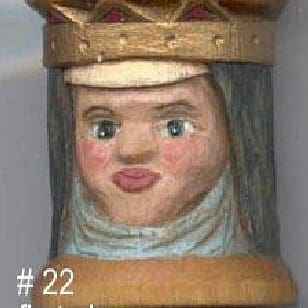
Often referred to as a negative, I’ve always thought of obsessions as a lifeline to exploration, creativity, joy and boundless energy. Being obsessed with something (rather than someone) results in any number of truly awe-inspiring things, such as these artists who carve thread spools into amazing miniature works of art.
Or Andrea Love whose website is filled with animations that she creates using felted wool.
How does one work through the fear that inevitably arises when creating if one isn’t obsessed with whatever it is you’re working on? I love creative, obsessive people (and thankfully so does my husband!)
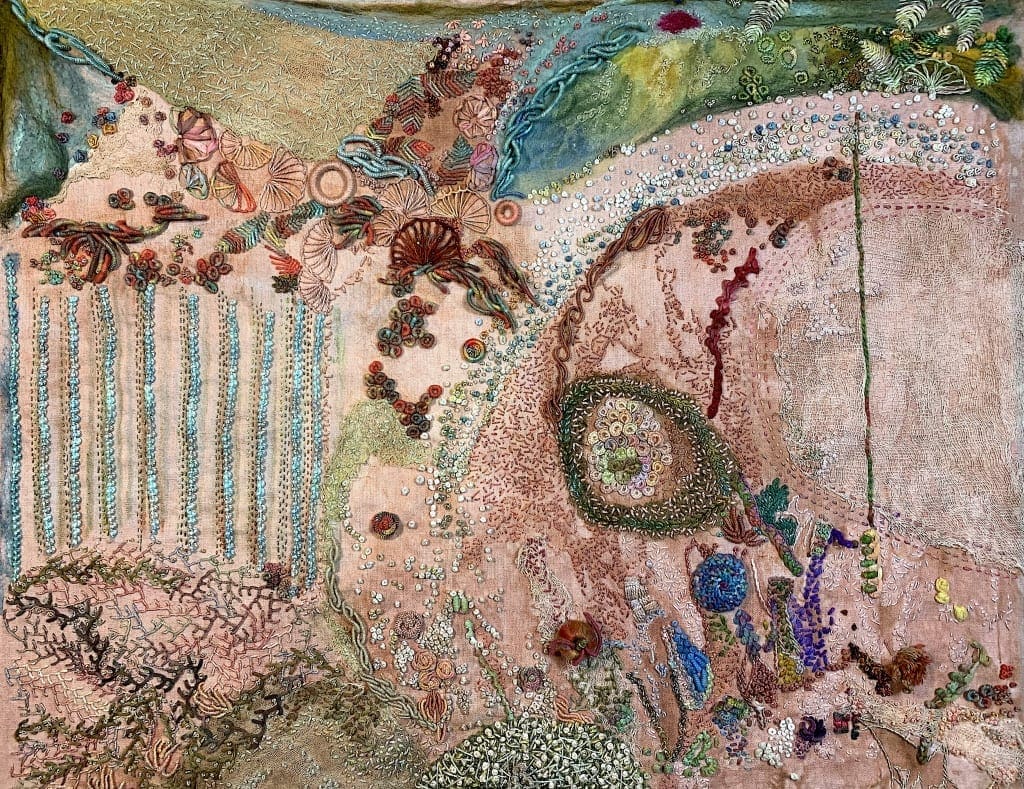
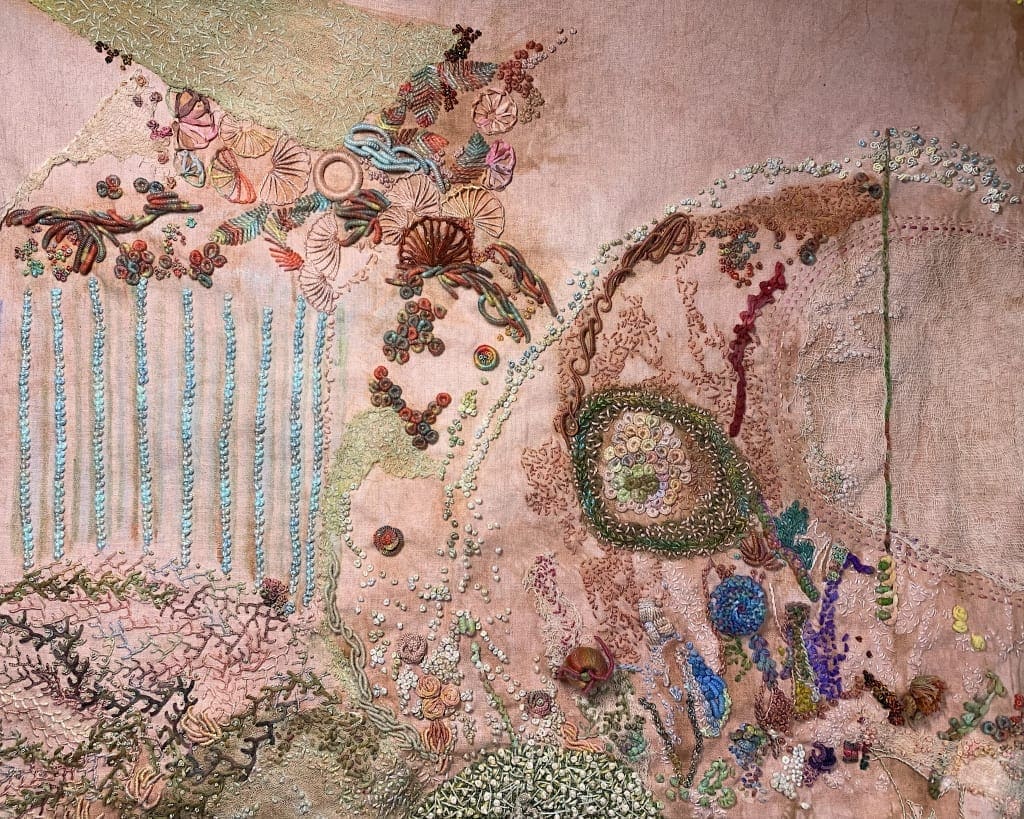
My latest hand stitched piece began as a challenge for myself – Pick a fabric that is on top of the pile and do something with it. And so it began. The fabric that lay before me is a color I find problematic. It’s a kind of pinkish, salmon flesh tone. There’s nothing wrong with the color, it just isn’t a color that speaks to me, particularly. But I had set myself up with a challenge and so I was determined to see where it took me. That was in the beginning of November.
The beginning…
I began playing around, trying different threads and thread weights adding texture in the form of hand dyed cheesecloth, wrapped wooden beads, etc. At one point in a moment of desperation I took some pastels and just painted right over the fabric and the stitching. Gasp! I know. I know. Sometimes taking drastic measures is exactly what’s needed, though.
And slowly, very, very slowly it began to take shape. There were plenty of moments when I thought – well, worse case scenario I’ll just use this piece to demonstrate various things, including what to do when you don’t know what to do or how to proceed!
But I kept at it and eventually began seeing things I liked, as opposed to all the things I didn’t. And once that happened, I began to turn a corner with this piece. However were it not for the fact that I’m obsessed with hand stitching, creating and designing, there’s no way I would have stuck it out. This piece would have been put into a corner and forgotten about. I credit my obsessiveness, dogged determination and perseverance as the reason that didn’t happen.
I think of color as having personality. I get a sense of colors much the way I get a sense of people at a dinner party. There are those who dominate the conversation, others who are quiet, yet have really interesting things to say once encouraged. Some people light up when seated next to someone they enjoy or are able to bond with, others prefer to ask questions and listen, but however they behave, all are interacting with each other in different ways. Color is similar.
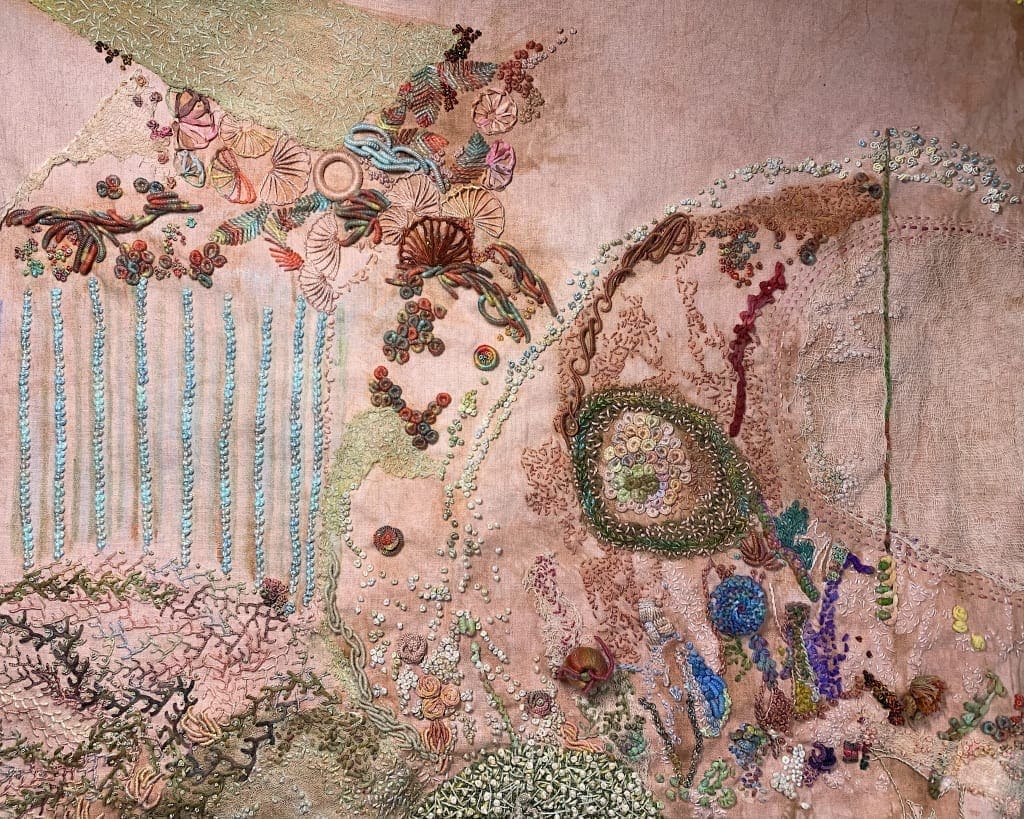
Olea – An improvisational stitching piece.
I did a Youtube video, Choosing Thread Colors a few months ago, but as I’m always thinking about color and since color is such a huge component of how I design, I thought I’d talk about it a bit more.
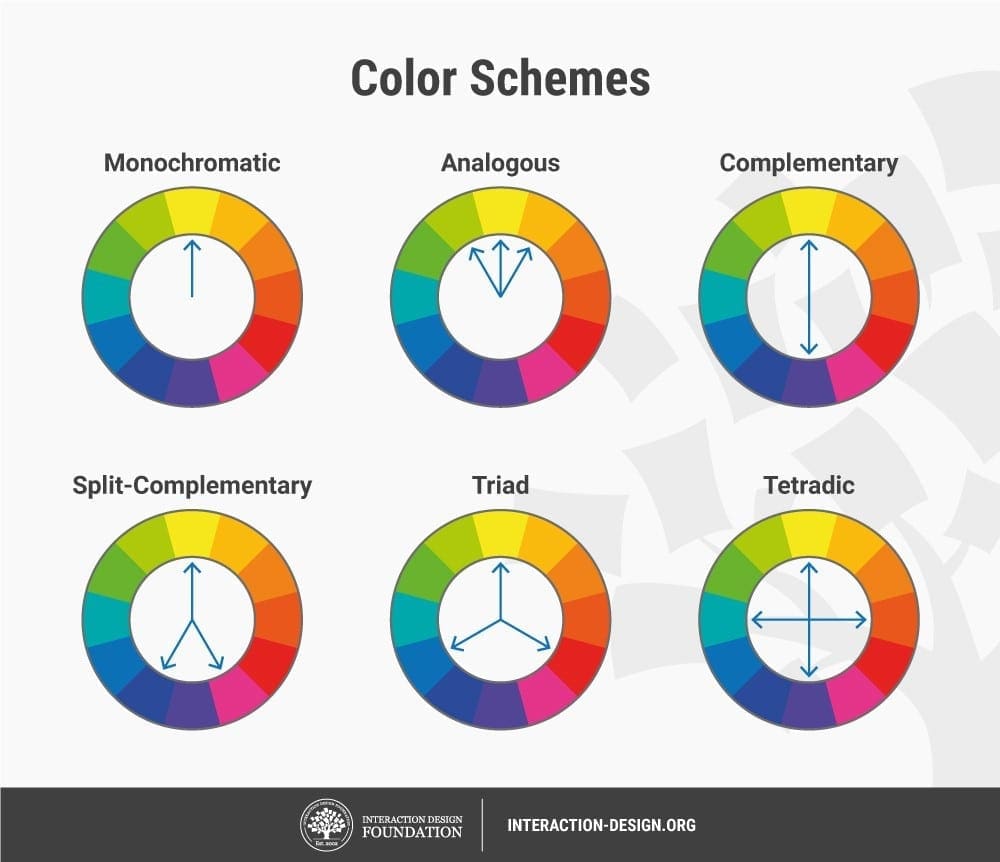
When I was at Parson’s we had semester long classes on the topic of color and color theory and while I’m grateful to know some of the basics such as cool vs warm, tint, shade, tone, etc, I also think it’s important to know what colors speak to you specifically. If someone tells you, green is a soothing color, which for many people it often is, but you happen to hate green, incorporating a great deal of green in your piece may cause you to not love the finished product.
I’m all about diversity. I want my eye to travel from one place to another. I want to see different things the longer I look. I like pattern, but I don’t want to focus only on pattern. I want to see things beyond pattern. I love curved shapes, but appreciate angular shapes as well. It’s the same with color. I try to listen to the colors I’m choosing and then make decisions on what I’m hearing. What I mean by that is if I’m working on a piece that has a really bossy color such as bright red (think of it as yelling at you, “Look at ME!”) then I’m going to think about what colors I can use around it. Now maybe I want that red to do all the talking and everyone else will be listening. Then I might use a lot of neutrals, maybe a bit of black somewhere, I might add something else, but I’m not going to add another bossy color to drown the red out. I want the red to stand out. On the other hand, if I don’t want the red diva to dominate, then that’s going to change what other colors I choose. But the point is I’m listening. I’m looking. I’m observing and then I’m making my decisions based on what I’m hearing.
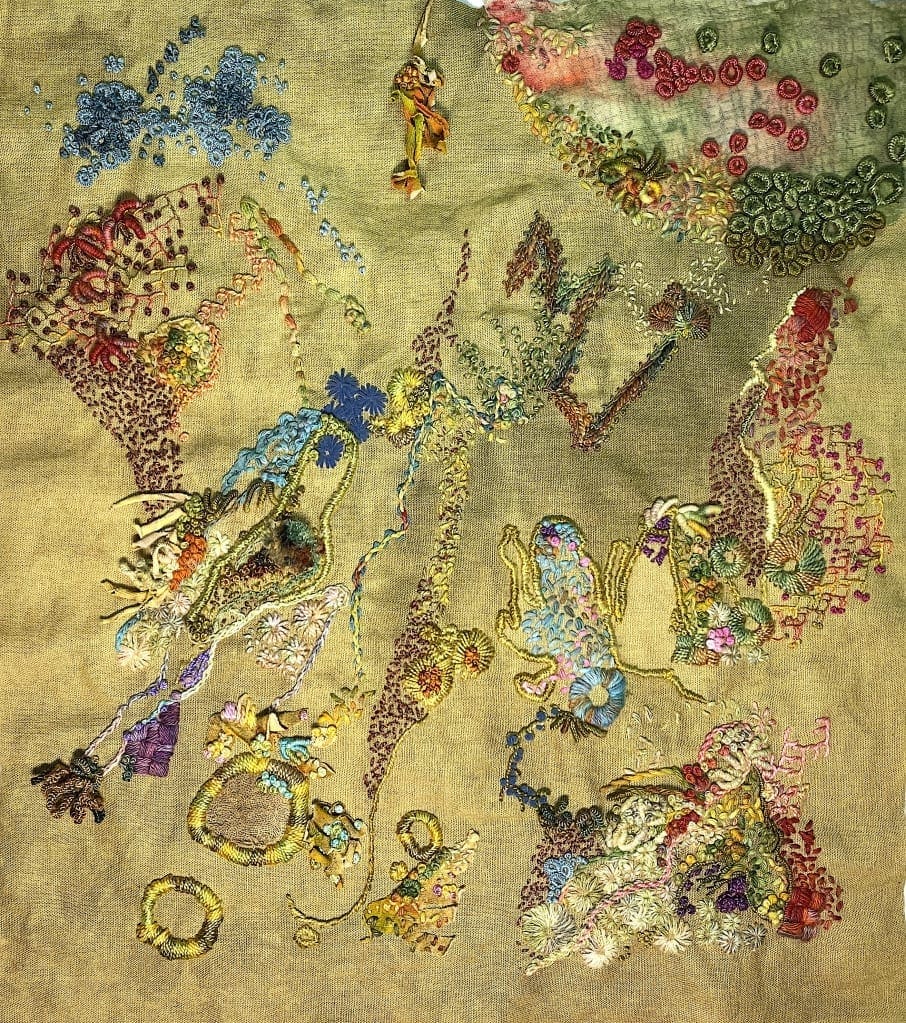
My current improvisational stitching piece – a work in progress
I love warm colors: Red, Orange, Yellow, but also love cool colors: Blue, Green, Purple. And once you start combining them you can come up with a wonderfully, fascinating mix of personalities and conversations!
I think about art all the time: the process, the way life impacts it… Wondering about how other people will see it, whether they will approve, like or dislike it, is the biggest buzz kill to creativity that I know of. But, I find, silencing those worries often difficult. The best steps I know to do is to dive in head first, and just go for it.
This last year has been one of exploration, diving in head first and going for it. If any of you are on Instagram, I post my works in progress almost daily. Below are three projects I finished this past year. I have four more in the works, but nowhere near completion.
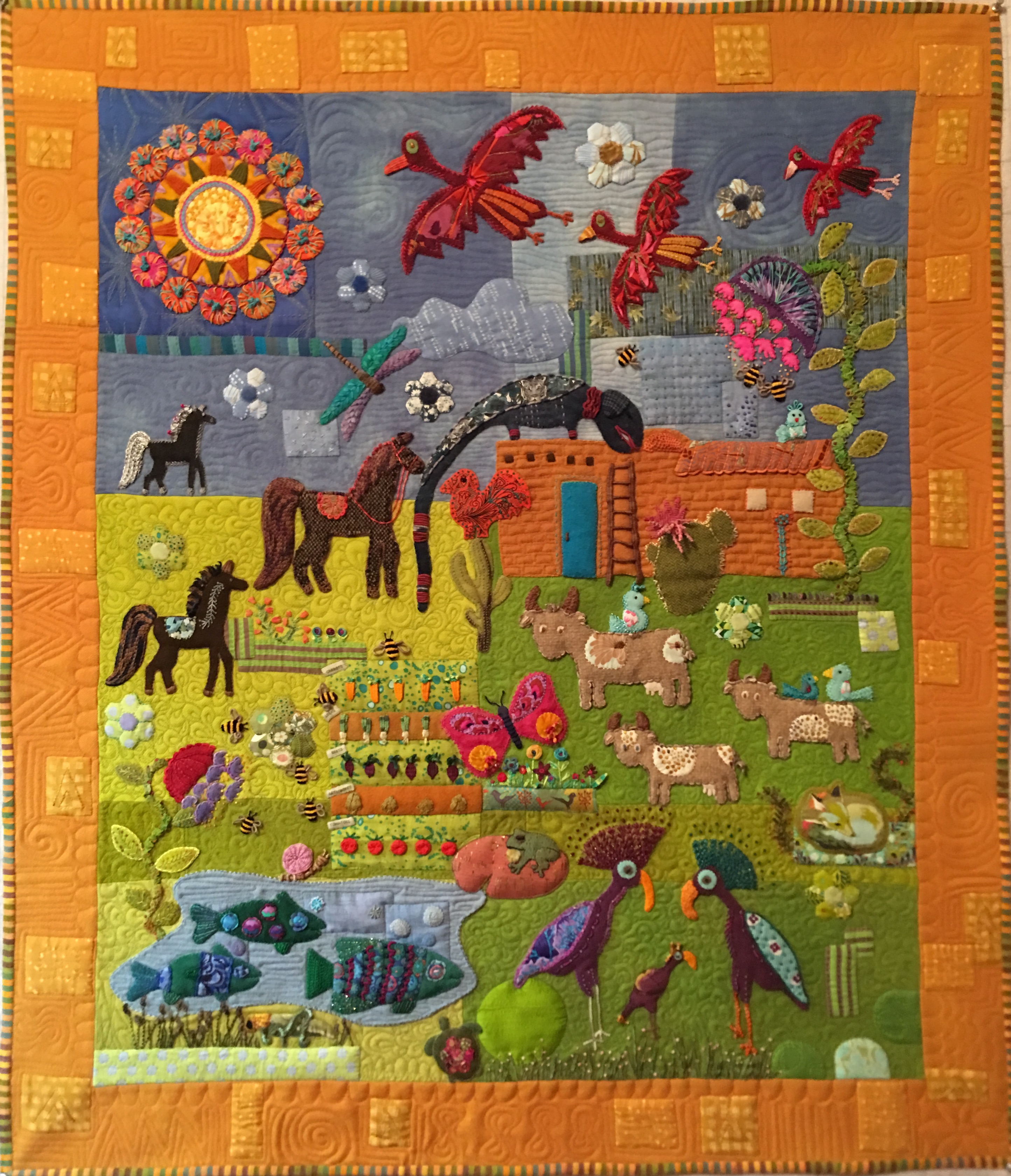
This first is titled: Wandering Through the Past and was inspired by the International Folk Art Museum in Santa Fe, New Mexico where I went for one of Sue Spargo’s fabulous workshops put on by Madeline Island School of the Arts. As I wandered through the museum much of the work felt oddly familiar. I remembered that my grandparents had honeymooned in Santa Fe & much of the furniture in their Colorado home came from that part of the world. As I designed this quilt, I began adding things from my childhood spent in Northern California with parents who collected modern & primitive art. Wandering Through the Past was thus born using wool, cotton, velvet & silk, & embellished with a wide variety of threads and stitches.
Wandering Through the Past
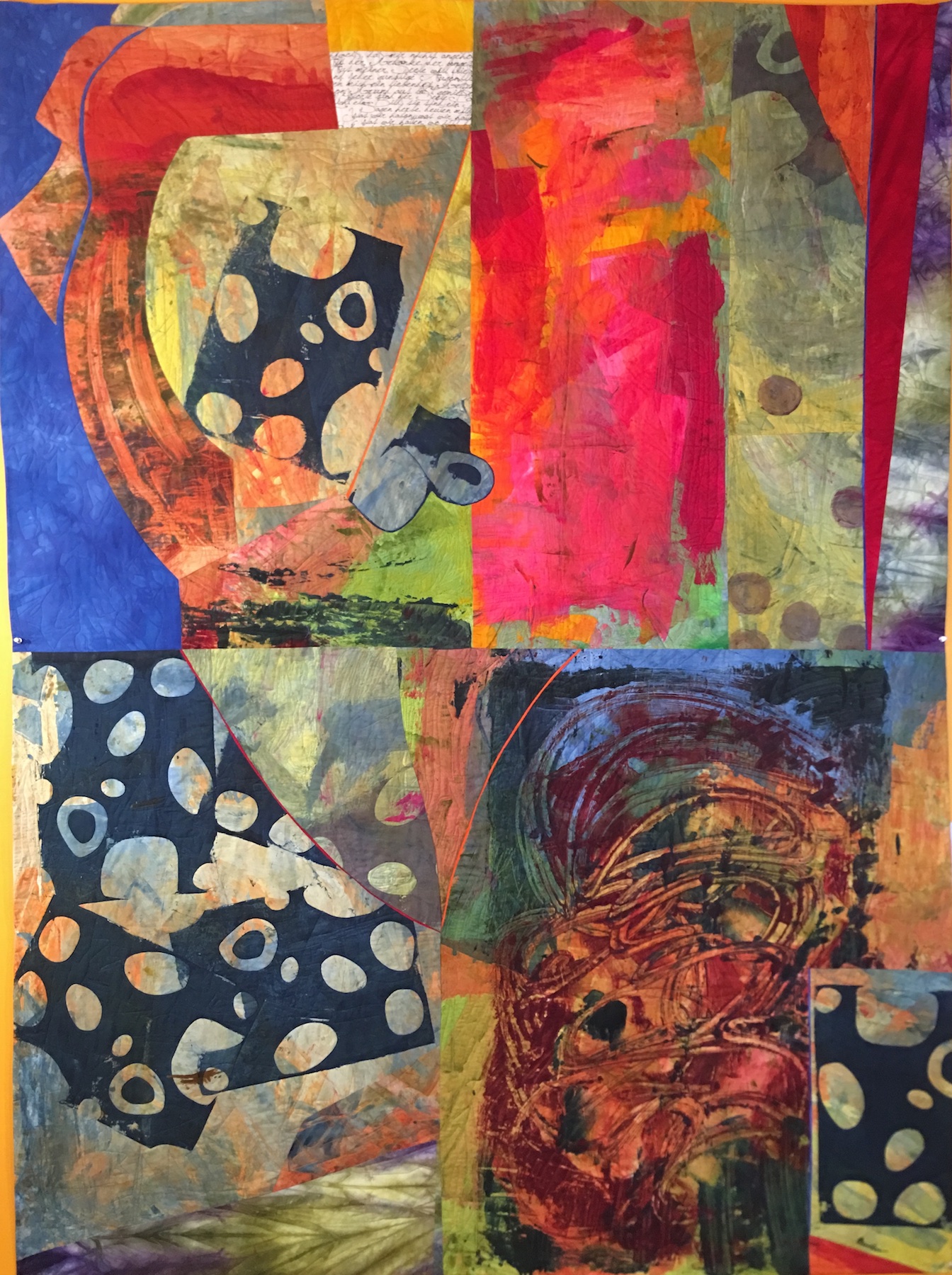
The next one is a complete departure from the one above in that most of the fabrics were hand dyed, hand painted, using stencils, screen printing and mono printing, and is not representational. All techniques I learned from the talented Pat Pauly in a workshop I took last April at the Pro Chem studio. It was the first time I’d ever tried my hand at improvisational piecing. I free motion quilted it following the general shapes and paint strokes.
Reflections
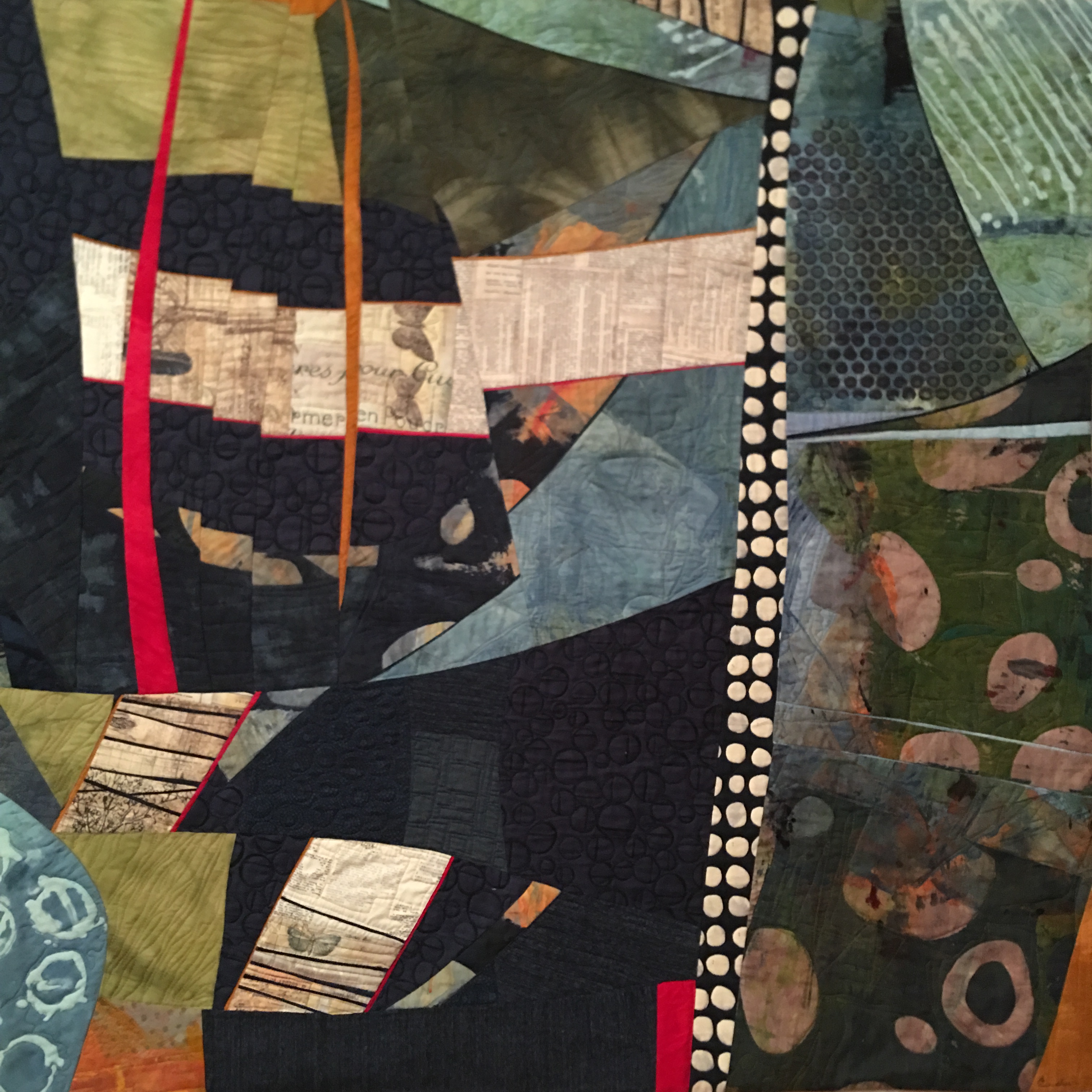
And this last one I began designing with the idea that I would use an old skirt from my mother. After a few weeks of struggle, I pulled out some of my hand dyed, Shibori, stencil printed, wax resist, silk screen & low immersion dyed fabrics. The fabric from the old skirt was pushed aside to make way for my hand dyed fabrics, which I then began piecing together with a few commercial prints. “Hope” was very bossy right from the start; demanding I use this or that fabric, slashing & piecing, reconfiguring… Mostly I just had to get out of the way & listen to its demands.


Recent comments